

How Is A Stepper Motor Used in 3D Printers
Nov 16, 2023
When you observe any 3D printers, you will find that all of them are fitted with several motors, and the most used of these motors are stepper motors. Unlike traditional motors, stepper motors move in discrete steps or increments, allowing for accurate control over position and speed. This inherent precision makes stepper motors an ideal choice for applications demanding fine-tuned movements, such as those found in 3D printers.
I How Stepper Motors Work in 3D Printing?
Stepper motors in 3D printers operate on a simple yet effective principle: they move in precise steps determined by the input signals received from the printer's control system. The printer's controller sends electrical pulses to the stepper motor, instructing it to rotate a specific number of steps. The rotation, in turn, translates to the movement of the printer's components, such as the print head or the build platform.
1. Coordination of Axes:
3D printers feature multiple stepper motors arranged along different axes – X, Y, and Z. The X-axis motor controls lateral movement, the Y-axis manages horizontal movement, and the Z-axis oversees vertical positioning. The coordination of these motors orchestrates the precise dance required to build each layer of the 3D print. Simultaneous movements of these axes create the intricate patterns and shapes specified by the digital design. The stepper motors, through their synchronized efforts, ensure that the print head moves with accuracy and consistency, layer after layer, ultimately forming the desired three-dimensional object.
2. Extruder Control:
The extruder, responsible for feeding and controlling the filament, relies on a stepper motor for precise regulation. The motor determines the rate at which the filament is fed into the hotend, a critical aspect of maintaining consistent material flow during the printing process. The controlled extrusion of filament is essential for achieving uniform layer thickness and overall print quality. The stepper motor's ability to precisely control the rotation translates directly to the accuracy of filament deposition, allowing for the creation of intricate details and complex geometries in the final print.
3. Impact on Layer Height and Resolution:
The inherent ability of stepper motors to move in discreet steps significantly influences the layer height and resolution achievable in 3D printing. The printer's firmware calculates the number of steps required to achieve a specific movement, allowing for the precise layering of material. This precision is crucial for achieving fine details, smooth surfaces, and accurate dimensions in the final printed object. Stepper motors, through their controlled and systematic movement, contribute to the high level of repeatability and accuracy that has become synonymous with modern 3D printing technology.
II Factors to Consider When Choosing the Right Stepper Motor for 3d Printing
But how to choose the right stepper motor for the 3D printers, several factors need be considered, such as the torque requirements, speed and resolution, motor type and size, etc.
1. Consideration of Torque Requirements:
Choosing the right stepper motor for your 3D printer begins with a careful assessment of torque requirements. The torque, or rotational force, is crucial for moving the various components of the printer, such as the print head and build platform. Evaluate the inertia and weight of these moving parts to determine the necessary torque for precise and controlled movements. It's essential to select a stepper motor with sufficient torque to overcome the resistance and ensure stable operation during the printing process. A motor with inadequate torque may result in missed steps and compromised print quality, while excessive torque can lead to unnecessary power consumption and wear on the motor.
2. Balancing Speed and Resolution:
The desired printing speed and resolution of your 3D printer are key factors in choosing an appropriate stepper motor. The step angle of the motor influences its resolution, with lower step angles providing finer control over movement. If high resolution is a priority, a motor with a lower step angle is preferable. However, it's essential to strike a balance with speed. Consider the trade-off between speed and resolution based on your specific printing requirements. Some applications may prioritize rapid printing, while others demand intricate details, requiring careful consideration of the stepper motor's step angle and speed capabilities.
3. Motor Type and Size Considerations:
The type and size of the stepper motor are critical aspects of the selection process. Choose between bipolar and unipolar stepper motors based on factors such as cost, ease of control, and the complexity of your control system. Additionally, evaluate the physical size of the motor to ensure compatibility with your 3D printer's design. Compact motors are suitable for space-constrained setups, while larger motors may be necessary for printers with heavier moving parts. Assess the electrical specifications, including voltage and current requirements, to guarantee seamless integration with your printer's power supply and control electronics. The right motor type and size, when aligned with torque, speed, and application requirements, form the foundation for an efficient and reliable 3D printing experience
In the realm of 3D printing, stepper motors are the unsung heroes, diligently translating digital designs into tangible creations with remarkable precision. In SIT, we offer a wide range NEMA size stepper motors, such as NEMA14, NEMA16, NEMA17, NEMA 23, NEMA34, etc. The best seller in SIT for the 3d printing industry are NEMA 17 stepper motor. Just tell us your requirements for the motors, and our engineering team will find the best solution for you.
You Might Also Like
-
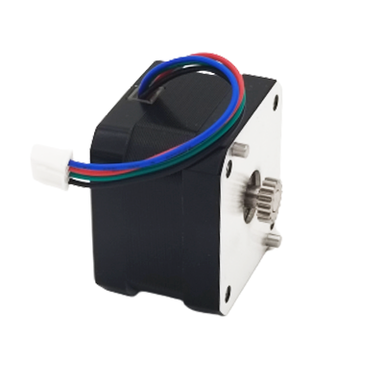
NEMA 17 Bipolar 1.8deg 0.24Nm 1.2A 3.36V 4 Wires Stepper ...
-

NEMA 17 Bipolar 1.8deg 0.16Nm 0.7A 3.1V 42x42x25mm Steppe...
-

Round NEMA 23 Bipolar 1.8deg 0.40Nm (56oz.in) 1.56A 11V Ф...
-

80x80mm 750w 3000rpm 2.4Nm 48VDC Servo Motor
-

22 Series Economy Planetary Gearbox
-

NEMA 17 Bipolar 1.8deg 0.21Nm(29.1oz-in) 0.42A 4.4V 42x42...