

Is A Driver Necessary For High-Speed Brushless DC Motor
Sep 26, 2023
At this stage, the attention of many automation equipment manufacturers is significantly directed towards high-speed brushless DC motors. They are increasingly inclined to replace motors afflicted with insurmountable drawbacks like low efficiency and high noise levels, such as three-phase asynchronous motors and stepper motors, with high-speed brushless DC motors. However, it's essential to recognize that the effectiveness of high-speed brushless motors is intrinsically tied to their accompanying drivers, a connection rooted in the very principles governing brushless motors.
High-speed brushless DC motors, in contrast to traditional counterparts, operate with an electronic commutator instead of a mechanical one. This shift towards electronic communication necessitates the presence of a dedicated drive circuit for a DC brushless motor. In the realm of high-speed brushless motors, the commutation circuit comprises two indispensable components: the drive and control systems. These components are often intricately intertwined, particularly in low-power circuits, where they are frequently amalgamated into a single Application-Specific Integrated Circuit (ASIC). In the context of high-power brushless DC motors, the drive circuit and control circuit can be discretely integrated.
The drive circuit assumes the critical role of supplying power to propel the armature winding of the motor, all while operating under the vigilant supervision of the control circuit. Over time, the configuration of the drive circuit has evolved from a linear amplification state to a pulse-width modulation switching state. This transformation is mirrored in the composition of the corresponding circuit, which has transitioned from transistor discrete arrangements to modular integrated circuits. The modular integrated circuit encompasses power bipolar transistors, power field-effect transistors, and isolated gate field-effect bipolar transistors. Although the utilization of isolated gate field-effect bipolar transistors may incur higher costs, the advantages in terms of reliability, safety, and overall performance make it a preferable choice.
In essence, the quest for efficient and low-noise high-speed brushless DC motors necessitates a holistic approach, considering both the motor itself and its intricate relationship with the accompanying driver circuitry. This synergy between motor and driver showcases the relentless pursuit of innovation within the field of automation.
You Might Also Like
-

NEMA 16 Unipolar 1.8deg 0.18Nm (25oz.in) 0.6A 11.2V 39x39...
-

NEMA 14 Bipolar 1.8deg 0.37Nm (51.4oz.in) 1A 7V 35x35x47m...
-

NEMA 23 Bipolar 1.8deg 0.52Nm(72.2oz.in) 2.8A 2V 57x57x41...
-

36V 4000RPM 0.238Nm 100W 3.9A Ф57x70mm Brushless DC Motor.
-
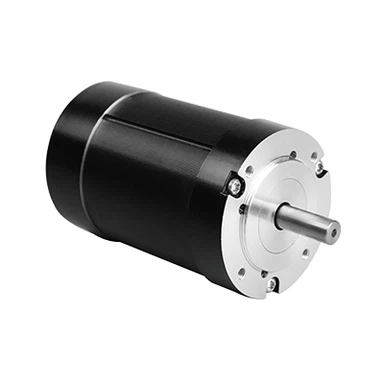
24V 1600RPM 0.418Nm 70W 4.2A Ф57x90mm Brushless DC Motor
-

NEMA 17 Unipolar 1.8deg 0.31Nm(43.1oz.in) 42x42x39mm 6Wir...