

The Difference Between Brushless DC Gear Motor And Stepper Gear Motor
Dec 21, 2023
What is a Brushless DC Gear Motor
A brushless DC gear motor is a sophisticated electric motor that merges the efficiency of a brushless DC motor with a gearbox. Unlike traditional brushed motors, BLDC motors use electronic commutation for smoother and more reliable operation. The addition of a gearbox allows for precise control over speed and torque, making BLDC gear motors versatile and efficient. They are commonly found in applications requiring continuous and controlled motion, such as robotics and industrial automation.
What is a Stepper Gear Motor?
A stepper gear motor is a specialized electric motor that integrates a stepper motor with a gearbox. Stepper motors move in discrete steps, providing precise control over position. The gearbox enhances the motor's capabilities by adjusting speed and torque. Stepper gear motors are ideal for applications requiring accurate and controlled movement, such as 3D printers, CNC machines, and robotics.
Key Differences
1. Control Method
Brushless DC motors are typically controlled using electronic commutation. The control system adjusts the current to the motor windings based on feedback from sensors, allowing for smoother and more efficient operation.
Stepper gear motors operate by receiving a sequence of pulses. Each pulse corresponds to a step, and the motor moves in discrete increments. Stepper motors are commonly used when precise position control is essential.
2. Continuous Rotation vs. Discrete Steps
BLDC gear motors provide continuous rotation and are well-suited for applications requiring smooth and continuous motion, such as in robotics and certain industrial applications.
Stepper gear motors move in discrete steps, making them suitable for applications where precise positioning is crucial, such as in 3D printers, CNC machines, and automation systems.
3. Torque and Speed Characteristics
BLDC gear motors typically offer a higher torque-to-inertia ratio, providing good torque characteristics, especially at higher speeds. They are efficient and well-suited for applications requiring high-speed rotation.
Stepper gear motors might have lower torque at higher speeds. Their torque characteristics can vary, and they are generally used in applications where precise control at lower speeds is more critical than high-speed operation.
4. Complexity and Control Precision
BLDC gear motors are known for their simplicity, reliability, and high efficiency. They require less complex control electronics compared to stepper motors.
Stepper gear motors have a more complex control system to ensure accurate positioning. Precise control can be achieved, but the complexity may be higher, and the system might require careful tuning.
5. Energy Efficiency
Brushless DC gear motors are generally more energy-efficient than stepper gear motors, especially at higher speeds. They operate with less power dissipation and are suitable for battery-powered applications.
Stepper gear motors may draw more power even when holding position, making them less energy-efficient in certain applications, particularly during idle periods.
The choice between a brushless DC gear motor and a stepper gear motor depends on the specific requirements of the application, with BLDC motors excelling in continuous motion and higher speeds, while stepper motors offer precise positioning and holding torque advantages.
You Might Also Like
-

NEMA 17 Stepper Motor With 10:1 Ratio Planetary Gearbox
-

NEMA 14 Bipolar 1.8deg 0.37Nm (51.4oz.in) 1A 7V 35x35x47m...
-

NEMA 23 Unipolar 0.9deg 0.39Nm(54.2oz.in) 57x57x41mm 6 Wi...
-

NEMA 17 Bipolar 3.75deg 0.054Nm (7.5oz.in) 0.5A 6V 42x42x...
-

22 Series Economy Planetary Gearbox
-
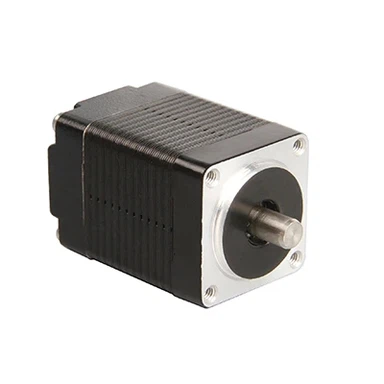
NEMA 8 Bipolar 1.8deg 0.013Nm(1.8oz.in) 0.2A 4.8V 20x20x2...