

What Are The Difference Between Servo Motor And Stepper Motor?
Dec 19, 2023
In modern industry, motors are an integral part. There are many types of motors, of which servo motors and stepper motors are two common ones. Although they are both used to control machine movements, there is a big difference between them. In this article, we will introduce the working principle, performance differences, and application areas of servo motors and stepper motors.
Working Principle Difference
Servo motors and stepper motors work on different principles. A servo motor is a closed-loop control system that controls the speed and position of the motor through feedback signals. Servo motors usually consist of a motor, encoder, controller, and power supply. The encoder is used to measure the position and speed of the motor, and the controller adjusts the motion of the motor according to the feedback signal from the encoder. Servo motors have high control accuracy and can realize high-speed and high-precision motion.
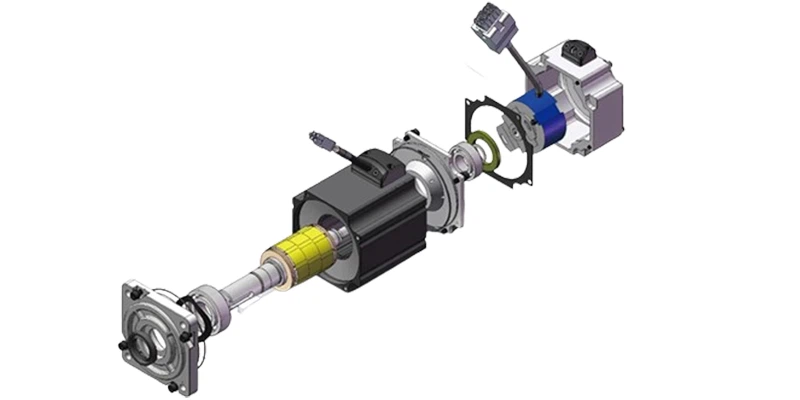
The stepper motor is an open-loop control system, which controls the speed and position of the motor by controlling the pulse signal of the motor. A stepper motor usually consists of a motor, a driver, and a controller. The controller sends pulse signals to the driver, and the driver converts the pulse signals into motion for the motor. The control accuracy of a stepper motor is relatively low, but it allows for precise position control.

Performance Difference
1. Different low-frequency characteristics
Stepper motors are prone to low-frequency vibration at low speeds. The vibration frequency is related to the load condition and the performance of the driver, and it is generally considered that the vibration frequency is half of the no-load starting frequency of the motor. This low-frequency vibration phenomenon decided by the working principle of the stepping motor is very unfavorable to the normal operation of the machine. When the stepper motor works at low speed, it generally should be used to damping technology to overcome the low-frequency vibration phenomenon, such as adding a damper on the motor, or using subdividing technology on the driver, and so on.
AC servo motors run very smoothly and do not vibrate even at low speeds. The AC servo system has a resonance suppression function, which can cover the lack of rigidity of the machinery, and the system has an internal frequency resolution function (FFT), which can detect the resonance point of the machinery so that it is easy to adjust the system.
2. Different torque-frequency characteristics
The output torque of the stepper motor decreases with the increase of rotational speed, and it decreases sharply at higher rotational speed, so its maximum working speed is generally 300-600rpm.
AC servo motor for constant torque output, that is, in its rated speed (generally 2000rpm or 3000rpm), can output rated torque, in the rated speed above the constant power output.
3. different overload capacity
Stepping motor generally does not have overload capacity. AC servo motor has a strong overload capacity. Panasonic AC servo system, for example, it has speed overload and torque overload capacity. Its maximum torque is three times the rated torque, which can be used to overcome the moment of inertia of inertial loads at the moment of starting. Stepping motor because there is no such overload capacity, in order to overcome this moment of inertia in the selection, often need to select a larger torque motor, and the machine does not need so much torque during normal operation, there will be a waste of torque phenomenon.
4. Different operation performance
Stepping motor control for the open-loop control, the start frequency is too high or the load is too large prone to losing steps or blocking the phenomenon of stopping the speed is too high prone to the phenomenon of overshooting, so in order to ensure accuracy of its control, it should be dealt with the problem of speed up and down. AC servo drive system for closed-loop control, the driver can be directly on the motor encoder feedback signal sampling, the internal composition of the position loop and speed loop, generally does not appear in the stepping motor of the phenomenon of loss of steps or overshoot, the control performance is more reliable.
Application Difference
Stepper motors usually move in steps, with each step being a fixed angle, and therefore perform well in applications that require simple open-loop control and relatively low accuracy. Therefore, stepper motors are suitable for some applications that do not require particularly high positioning accuracy, such as printers, scanners, inkjet printers, and so on.
In contrast, servo motors perform better in applications with more stringent motion control requirements. Servo motors use a feedback system that provides higher control accuracy and dynamic response. This makes servo motors suitable for applications that require high-precision positioning, speed, and position control, such as CNC machine tools, robots, aircraft, etc. Servo systems achieve more precise motion control by constantly adjusting the output to eliminate errors.
In short, although servo motors and stepper motors are both used to control machine movements, there is a big difference between them. The Servo motor is a closed-loop control system with high control accuracy, suitable for high-speed, high-precision movement; the stepper motor is an open-loop control system with lower cost, suitable for precise position control. In practical applications, the appropriate type of motor should be selected according to specific needs.
You Might Also Like
-

NEMA 17 Bipolar 1.8deg 0.65Nm 1.5A 4V 42x42x60mm Stepper ...
-

28 Series Economy Planetary Gearbox
-

NEMA 23 Bipolar 0.9deg 1.15Nm(159.7oz.in) 2.8A 2.5V 57x57...
-

NEMA 23 Bipolar 1.8deg 1.02Nm (142oz.in) 2.8A 2.5V 57x57x...
-

NEMA 17 Unipolar 1.8deg 0.31Nm(43.1oz.in) 42x42x39mm 6Wir...
-
57mm Geared Brushless DC Motor