


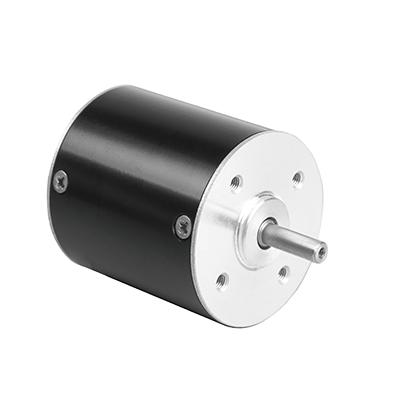
24V 5000RPM 0.029Nm 15W 0.98A Ф36x50mm Brushless DC Motor
Manufacturer Part Number: 36BL02502-0015-XXX
Frame Size: Ф36mm
Body Length: 50mm
Rated Voltage: 24V
Rated Speed: 5000RPM
Rated Torque: 0.029Nm
Power: 15W
- Fast Delievery
- Quality Assurance
 Customization Available
Product Introduction
General Specification
|
Winding Type |
star |
|
Shaft Axial Play |
0.025mm |
|
Ambient Temperature |
-20℃~55℃ |
|
Ambient Humidity |
<85% ( without condensation ) |
|
MAX.Radial Force |
15N@10mm from the flange |
|
MAX.Axial Force |
10N |
|
Insulation Class |
Class B |
|
Insulation Resistance |
100MΩMin.@500VDC |
Wiring
|
Lead No. |
Lead Color |
Lead Gauge |
Function |
Description |
|
1 |
Red |
UL1007/26AWG |
VCC |
Supply Voltage for Hall Sensors |
|
2 |
Black |
GND |
Ground for Hall Sensors |
|
|
3 |
Yellow |
HALL A |
||
|
4 |
White |
HALL B |
||
|
5 |
Blue |
HALL C |
||
|
6 |
Orange |
UL1007/18AWG |
Phase A |
|
|
7 |
Green |
Phase B |
||
|
8 |
Brown |
Phase c |
Technical Specification
|
Model No. |
Rated Voltage |
Speed |
Rated Torque |
Power |
Rated Current |
No-load Speed |
No-load Current |
Resistance/line-line |
Inductance/line-line |
Back EMF Constant |
Length |
|
VDC |
rpm |
N.m |
W |
A |
rpm |
A |
Ω |
mH |
V/krpm |
mm |
|
|
36BL02502-0015-XXX |
24 |
5000 |
0.029 |
15 |
0.98 |
7400 |
0.18 |
3.15 |
5.81 |
3.9 |
50 |
Mechanical Dimension

FAQ
Q: What is the role of Hall effect sensors in BLDC motors?
A: Hall effect sensors play a crucial role in the operation of BLDC (Brushless DC) motors. They are used to provide feedback on the rotor position, which is essential for accurate commutation and control of the motor. Here's a closer look at the role of Hall effect sensors in BLDC motors:
1. Rotor Position Sensing: BLDC motors require knowledge of the rotor position to determine the correct timing and sequence of energizing the motor windings. Hall effect sensors are commonly used for this purpose. These sensors are placed in fixed positions around the stator of the motor, typically in close proximity to the rotor magnets.
2. Detecting Magnetic Field Changes: Hall effect sensors work based on the Hall effect, which is the generation of a voltage difference across a conductor when it is exposed to a magnetic field. When the rotor magnets pass near the Hall effect sensors, they generate changes in the magnetic field, which are detected by the sensors.
3. Generating Position Signals: The Hall effect sensors provide position signals to the motor controller, indicating the rotor's position relative to the stator. These signals are typically in the form of digital pulses or logical states (high or low). The number and placement of the sensors determine the resolution of the rotor position detection.
4. Commutation Timing: By analyzing the position signals from the Hall effect sensors, the motor controller determines the appropriate timing for commutating the motor windings. The controller knows which windings should be energized and in what sequence to generate the rotating magnetic field necessary for motor operation.
5. Closed-Loop Control: Hall effect sensors also enable closed-loop control in BLDC motors. By continuously monitoring the rotor position, the motor controller can adjust the commutation timing and optimize motor performance. This allows for improved speed control, torque control, and overall motor efficiency.
The accurate and timely feedback provided by Hall effect sensors allows for precise and reliable commutation of the BLDC motor, resulting in smooth and efficient motor operation. While Hall effect sensors are widely used, it's worth noting that sensorless control techniques that rely on back electromotive force (EMF) estimation or advanced algorithms are also employed in certain BLDC motor applications to eliminate the need for external position sensors.
Hot Tags: 24v 5000rpm 0.029nm 15w 0.98a ф36x50mm brushless dc motor, China 24v 5000rpm 0.029nm 15w 0.98a ф36x50mm brushless dc motor manufacturers, suppliers, factory


